
Santa Barbara County Records Coverage
Openness is not the same for every file. A recorder index is public, yet a certified vital record may require an authorized applicant. A court register may be visible while its document images remain limited. The table leads to the right custodian and shows the access channel documented for each major record set.
| Record Set | Custodian | Online Index | Coverage | Access |
|---|---|---|---|---|
| Deeds, liens, maps | County Clerk-Recorder | Official Records Search | Name index states 1900-current; office holdings 1850-current | Free index; paid copies |
| Civil, family, probate, small claims, traffic | Santa Barbara Superior Court | Public and Civil portals | Non-confidential, non-sealed cases | Online register; some images or files at court |
| Criminal court | Santa Barbara Superior Court | No online criminal index | Public files subject to limits | Public terminals and records windows |
| Parcel and tax data | Assessor; Treasurer-Tax Collector | Parcel and tax portals | Current assessment; 10 years of paid bills online | Free lookup; address or APN based |
| Birth, death, marriage | County Clerk-Recorder; CDPH | Copy-order portal, not a broad name index | County events; marriages issued here back to 1850 | Authorized or informational copies |
| Jail custody | County Sheriff | Who Is In Custody | Current custody | Public search with legal-use warning |
Juvenile and adoption matters, sealed files, confidential marriages, protected voter addresses, and confidential identifiers are not made open by a general request. Court case files follow court rules, while agency administrative files fall under the California Public Records Act, or CPRA.
Santa Barbara County Recorder Index Access
The Clerk-Recorder Official Records Name Search covers recorder documents from January 1, 1900 through its current update date. It is refreshed Monday through Friday. Separate county sources describe total official-record holdings from 1850 to the present, a historical index for 1931 through 1974, and the live system for post-1975 real estate records. Those dates overlap because an online search range is not the same as all material held by the office.
| Search Control | Use | Format |
|---|---|---|
| Name | Find an individual or organization | Enter people as Last First, without punctuation |
| Recording Date Start | Set the earliest date | Optional date |
| Recording Date End | Set the latest date | Optional date |
| Advanced Name Searching | Broaden name matching | Optional control |
| Exact or wildcard | Choose strict or broad terms | Wildcard ignores order; spaces act like OR |
Use a surname and first initial when the full name is too narrow. The search menu also offers document type, document number, map book/page, and advanced modes. An index is a finding list, not the legal instrument itself. A copy costs $10 per document, and certification adds $2 per document.
The county real estate records overview shows how current and historical access paths divide:
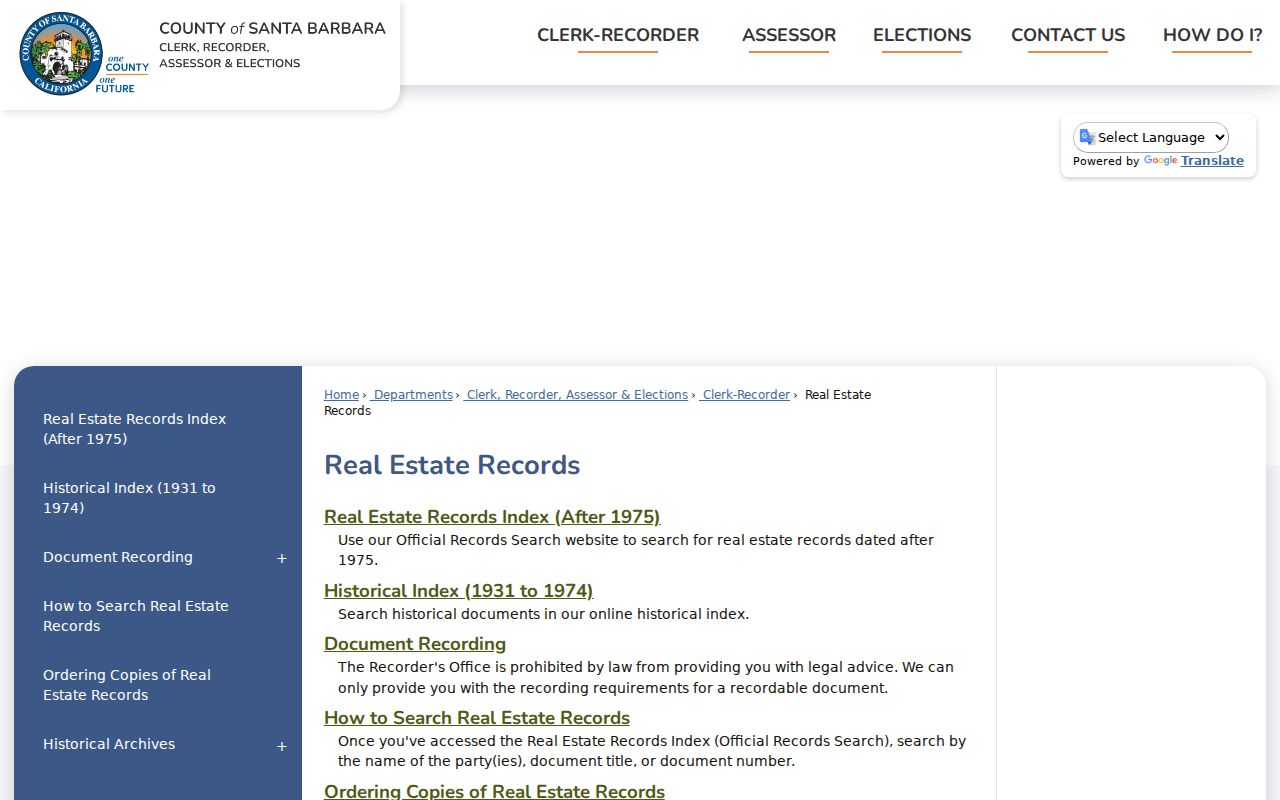
Its links help distinguish post-1975 searches, the 1931-1974 historical index, copy orders, and the broader archives.
Reading Santa Barbara County Records Dates
Three dates answer three different questions. The 1850 date describes what the office maintains. The 1931-1974 span identifies a dedicated historical online index. The 1900-current statement belongs to the current name-search page. A failed web search therefore does not prove no older record exists.
The Historical Archives available-records page states the scope of the county collection:
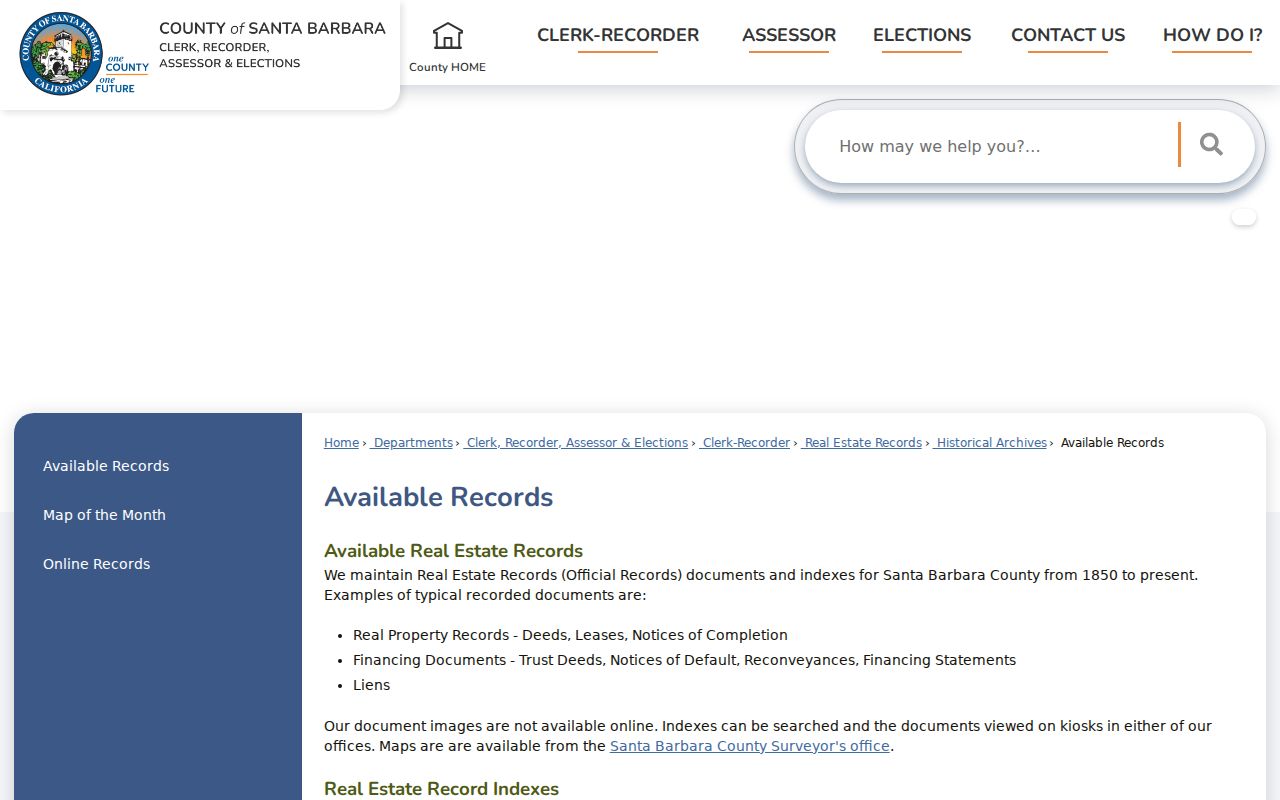
For material outside a portal or for an image not posted, use the historical index, contact the Clerk-Recorder, or arrange office access. A digitized Water Claims Book covering 1877-1918 adds names tied to ranches, land use, and early water rights.
Note: Online coverage is broad, but the county’s physical and archival holdings reach farther back than every current search screen.
Santa Barbara County Public Records Custodians
The Clerk-Recorder, Assessor, Elections, court, and Sheriff do not share one database. The county seat is Santa Barbara, with major county service centers in Santa Maria and Lompoc. Court terminals at the Figueroa, Miller, and Lompoc divisions make geography especially important when remote access stops at a register.
County Clerk-Recorder
Official records, marriages, vital copies, fictitious business names, and historical archives
805-568-2250
County Assessor
Parcel details, assessed values, recent sales, and assessor maps
Superior Court
Civil, criminal, family, probate, small claims, and traffic case records
Sheriff Records Bureau
Incident and accident report requests after availability is confirmed
805-681-4180
Santa Barbara County Court Records Limits
The Superior Court Public Portal supplies registers of action for non-confidential, non-sealed civil, criminal, family law, probate, small claims, and traffic cases. A register of actions is the dated list of events filed in a case. The Civil Portal can also display civil images allowed by California Rules of Court rule 2.503. Family and probate images are not available through that Civil Portal, even when a public register exists.
The court says no online criminal index is currently available. Searchers must use public terminals in the Figueroa, Miller, or Lompoc division lobbies and request a file through the records window. A case number is the best key. Case-number and citation-number modes are public on the separate traffic system, while its party and business modes require login.
- Index
- A list used to locate a filing or case, not the full document.
- Image
- A digital view of the filed document, when remote display is allowed.
- Certified copy
- An official copy authenticated by the custodian.
- Custodian
- The office responsible for keeping and releasing a record.
- Exemption
- A legal rule that permits or requires information to be withheld.
Santa Barbara County Property Records Systems
The Assessor portal begins with an assessor parcel number, or APN, and a property address, not an owner-name field. Its fields include parcel number, house number, unit, street name, sort choice, and assessor map book/page. A situs address means the physical property location. Results can show APN, situs, net assessed value, land value, improvements, and a map link. Assessor maps are informational rather than legal documents.
The Tax Collector adds all unpaid bills and ten years of paid bill history online. County GIS then supplies parcelized landbase, zoning, and land-use layers. The county mapping and GIS hub introduces those map resources:
Use maps to interpret parcel geography, but use deeds and recorded maps for legal descriptions. Try a partial street name without suffixes such as St, Ave, or Blvd when the assessor returns no match.
City Permit Records by Address
Inside the City of Santa Barbara, planning and permit files use separate city systems. The Property Records Database holds Planning Files, Street Files, and Plan Inventory. For a multi-unit address, the city recommends adding an asterisk after the street number. Active permit status can be searched in Accela by address, permit number, or parcel without an account. Plans remain copyright protected and may require an appointment for in-person viewing.
The City Accela Citizen Access portal provides the current permit and application entry point:
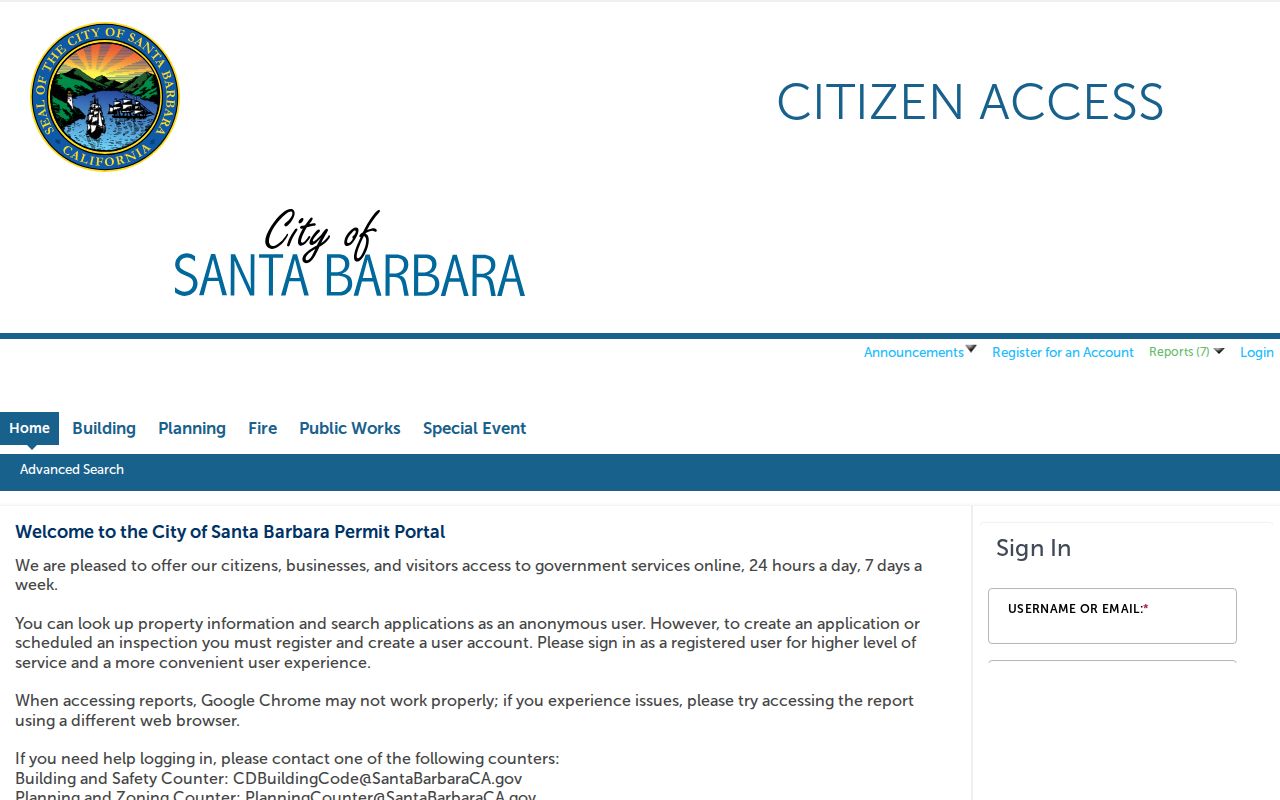
This city channel applies to property within city jurisdiction. County Planning and Development has its own parcel-based permit history for county areas, while other cities maintain their own files.
Note: A Santa Barbara mailing address does not always identify the agency; city limits and unincorporated county lines control the custodian.
Santa Barbara County Vital Records Access
California does not use a simple rule that vital records become open after a set number of years. Health and Safety Code sections 103525-103526 distinguish authorized certified copies from informational copies. Informational birth, death, and public marriage copies carry a warning that they cannot establish identity. Authorized copies require statutory eligibility, identity proof, and a sworn statement. Confidential marriage copies are limited to the parties or a court order.
The county issues birth, death, fetal death, and marriage copies for events within its scope. Current 2026 fees are $34 for birth, $26 for death, $23 for fetal death, and $19 for marriage. Authorized applicants may appear in person or print the application, complete the required notarized sections, and return it by mail or fax. Email is not accepted. CDPH is the statewide fallback and amendment authority. Divorce records belong to Superior Court, not the Clerk-Recorder.
Santa Barbara County Custody and Reports
The Sheriff’s Who Is In Custody lookup searches first name, last name, or inmate number, also called a CID. Public results can include where a person is held, charges, custody status, and CID. The Sheriff warns against relying on the lookup for legal action. State prison custody is handled through the CDCR Inmate Locator, while the California Megan’s Law registry has separate statutory use limits.
Sheriff reports are request-based. Call the Records Unit first to confirm the report is available. The research states that a report often takes seven to ten days to be finalized and approved, after which the unit may take up to ten days to review release. The form asks for report or citation number, date, location, reason, requester category, certification, and contact details. Listed fees are $15 for an accident report, $25 for photos, $15 for a crime report for victims only, and $40 for an accident report with photos.
What California Records Withhold
Public access has firm boundaries. Juvenile, adoption, sealed, and some law-enforcement files are restricted. Voter signatures, driver’s license numbers, Social Security numbers, and protected residence addresses stay confidential. DMV records are limited by federal law. Vital certificates may omit protected data, and court orders can seal or redact information.
California Safe at Home provides a substitute mailing address and mail forwarding as part of a safety plan. County confidential voter registration likewise keeps residence data out of lists, rosters, and indexes prepared by Elections. An ordinary CPRA request cannot override these laws. Nor does a commercial privacy deletion request erase a government record kept under a retention or disclosure rule.
Lawful use. Access records only for a lawful personal, family-history, property, or civic purpose. Never use a record to stalk, harass, threaten, or expose a protected person.
Santa Barbara County Records Fees
Price depends on the authority behind the copy. CPRA duplication charges generally cover direct duplication costs, but recorder, court, vital, and Sheriff documents can carry fees set by separate law or schedule. Inspection may be free even when a paper, image, or certified copy costs money.
Ask whether an index result is enough before ordering. A recorder index can identify the document number and date, while certification is useful when an authenticated copy is required. CDPH retains its statutory fee as a search fee even when no vital record is found. City police records state a charge of $0.20 per page and no fee for electronic copies when no programming or extraction charge is needed.
Note: Request an estimate before authorizing a large copy order, and specify electronic delivery when the custodian offers it.
Request Santa Barbara County Public Records
The California Public Records Act, Government Code section 7920.000 and following, opens state and local agency records unless an exemption applies. Section 7922.525 protects inspection during office hours. Sections 7922.530 and 7922.535 cover prompt access, direct duplication costs, and the response timetable. An agency generally has ten days to decide whether it holds disclosable records and may add up to fourteen days in unusual circumstances.
- Identify the office that created or received the record. Court case files use court procedures rather than CPRA.
- Check its portal, archive, or public terminal first. Save any document, parcel, case, or report number.
- Describe identifiable records, a date range, subject, and preferred format. Do not ask the agency to answer questions or create a new report.
- Submit through the listed portal, form, email, mail, phone, or counter channel. Keep the request and confirmation.
- Review the response, cited exemption, and cost estimate. Narrow an overbroad request or ask for segregable, non-exempt portions when needed.
If access is denied, ask the agency to state the legal basis. A focused revision may resolve a scope problem. Further review can include agency counsel or a court petition, but no outcome is guaranteed. Board minutes, recorder archives, and the unusual 1877-1918 Water Claims Book also show why an archive inquiry can succeed when a modern portal does not.
Records request rule. A custodian must search for reasonably described existing records, but it need not conduct research, answer interrogatories, or build a new record.