
Find People Through Santa Barbara County Records
Choose the first record by the fact already in hand. A full name is best tested in the Clerk-Recorder index, court registers, business filings, and license records. An old street address points instead to the Assessor, tax bills, permit files, and city property archives. A death date or relative's name belongs in obituary, probate, cemetery, and vital-record sources. Each trail has a different keeper, so a missed result in one portal does not end the search.
Names need care in Santa Barbara County. The recorder expects an individual name in last-name-first order. Court access changes by case type. Property tools use an address or assessor parcel number, called an APN, rather than a public owner-name field. Save the document number, case number, APN, date, and spelling shown in each result. Those facts make the next search precise.
- Search the recorded-document name index with the full surname, then repeat with a first initial and a date range.
- Check the Superior Court register for public civil, probate, family, small claims, traffic, or criminal case activity.
- Convert an address to an APN through the Assessor, then follow that number into tax, map, permit, and deed records.
- For a deceased resident, join probate entries with an obituary, cemetery index, marriage record, and recorded deed.
- When no portal holds the needed detail, send a narrow request to the agency that created or keeps the record.
Note: A shared name is not proof of identity; confirm it with a second fact such as date, address, relative, parcel, or case number.
Santa Barbara County People Records Offices
The county combines Clerk-Recorder, Assessor, and Elections functions in one elected structure, but each division keeps a distinct record trail. The Recorder indexes deeds, liens, maps, releases, and other filed documents. The Clerk handles county marriage records and fictitious business names. The Assessor turns a street address into an APN and assessed-value record. The Superior Court keeps case files, while City of Santa Barbara Records & Archives holds planning, street, and plan files for city property.
The offices also preserve offline routes. The recorder has historical archive holdings that reach beyond the live web index. Court records staff and lobby terminals fill gaps left by remote-access rules. City property plans may require an appointment even when the permit status is visible online. Detailed access rules and copy procedures belong with Santa Barbara County public records access.
Santa Barbara County Clerk-Recorder
Official records, marriages, and clerk filings
County service centers
805-568-2250
Santa Barbara Superior Court
Civil, criminal, family, probate, and traffic cases
Figueroa, Miller, and Lompoc divisions
Records windows and public terminals
Santa Barbara City Records
Planning files, street files, and plan inventory
Records & Archives Counter
805-564-5485 x4548
The City of Santa Barbara directory shows how official names and roles appear in a current municipal source.
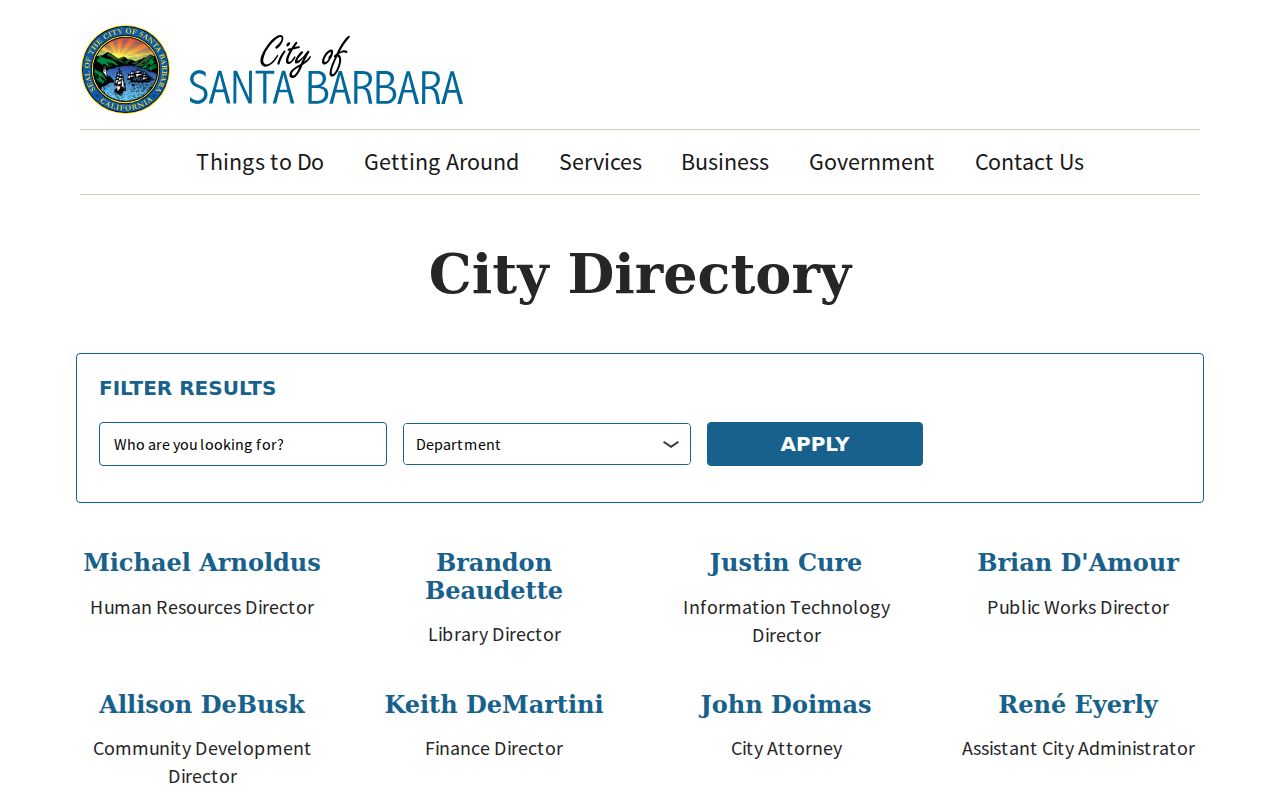
The directory is useful for finding the right public official or department, while the office cards identify where record-level searches continue.
Search Santa Barbara County Recorder Names
The Official Records Name Search is the strongest countywide starting point when a person's name is known. It covers indexed recorder documents from January 1, 1900 through the update date, with updates Monday through Friday. Enter an individual as Last First without punctuation. A last name plus first initial broadens the result set. An exact search follows the entered order, while wildcard behavior ignores word order and treats spaces as an implied OR. That difference matters for compound surnames, initials, particles, and Spanish naming patterns.
Use dates to separate people who share a name. A result may lead to deeds, deeds of trust, liens, releases, easements, reconveyances, notices, maps, or other recorded instruments. An index is a finding aid, not the certified record. The copy flow charges $10 per document and $2 more for certification. Office holdings run from 1850 to the present, and a separate historical index covers 1931 through 1974, so a blank live search may still require the historical archive.
| Recorder field | Input | How to use it |
|---|---|---|
| Name | Required for name mode | Use Last First; try surname plus first initial. |
| Recording Date Start | Optional date | Set the earliest likely filing date. |
| Recording Date End | Optional date | Close the range to reduce same-name hits. |
| Advanced Name Searching | Optional setting | Test exact and broader name behavior. |
| Other search tabs | Document type, number, map book/page | Reuse facts found in an earlier result. |
- Grantor
- The person or organization transferring an interest in a recorded document.
- Grantee
- The person or organization receiving that recorded interest.
- Index
- A searchable list that points to a filing; it is not the full filed instrument.
- Certified copy
- An official copy authenticated by the records custodian.
Turn Santa Barbara County Addresses Into Names
When only an address remains, first use the Assessor Parcel Details and Value Notice Lookup. Its public form accepts a parcel number, house number, unit, and street name, then can sort results by parcel or street. Try a partial street name and leave off suffixes such as Street, Avenue, or Boulevard. A result can show the APN, situs address, net assessed value, land value, improvements, and an assessor map link. A situs address is the physical location of the parcel.
The public form captured in the research did not expose an owner-name search. Use the APN to bridge systems instead. Tax tools show unpaid bills and ten years of paid bill history. County GIS adds parcelized landbase, zoning, and land-use layers. City Accela records can be searched without an account by address, record number, or parcel for public permit information. Older city planning and street files sit in the Property Records Database, which advises placing an asterisk after a multi-unit street number.
Lawful use: Use address and person records for legitimate personal research. Never use a public record to stalk, harass, threaten, or harm someone.
Note: Assessor maps are informational rather than legal documents; recorded deeds and maps control the legal description of a parcel.
Search Santa Barbara County Court Records
The Superior Court's Public Portal displays registers of action for non-confidential, non-sealed civil, criminal, family law, probate, small claims, and traffic cases. A register of action is the court's chronological list of filings and events. The separate Civil Portal can show civil registers and allowed non-confidential civil document images. California Rules of Court rule 2.503 limits remote display for some case types, so an online register does not mean every filing can be opened from home.
The Superior Court case-search agreement makes that remote-access boundary visible.
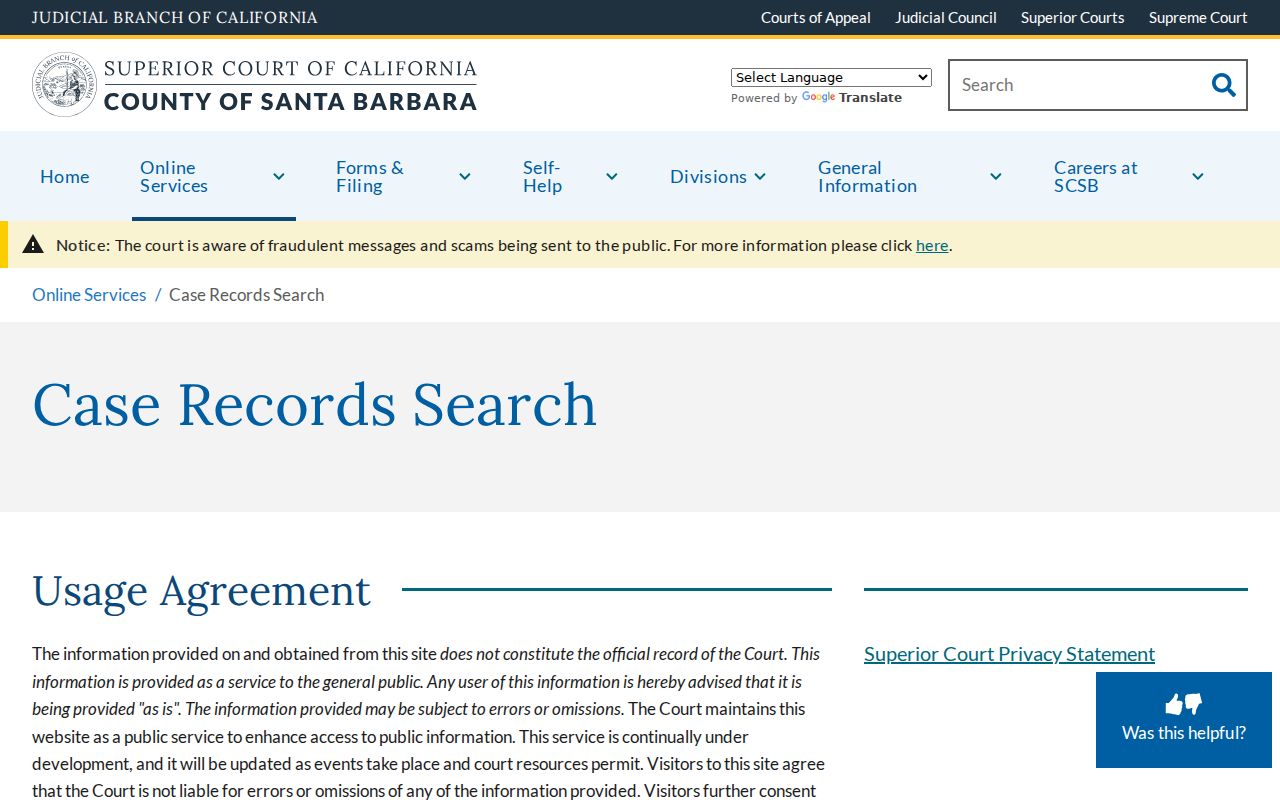
The agreement is the gateway to public case information, but court staff and records windows remain the fallback when an image or index is not remotely available.
| Santa Barbara court source | People-search coverage | Access route |
|---|---|---|
| Public Portal | Public registers for civil, criminal, family, probate, small claims, traffic | Online for non-confidential, non-sealed cases |
| Civil Portal | Civil registers and permitted civil images | Online within rule 2.503 limits |
| Criminal index | Criminal file location and index research | Public terminals at Figueroa, Miller, and Lompoc |
| Traffic and citation search | Case-number and citation-number paths | Public modes; party and business search require login |
| Federal court | Central District of California federal cases | PACER name, party, court, or case search with federal fees |
The separate traffic and case-number search shows the available public modes.
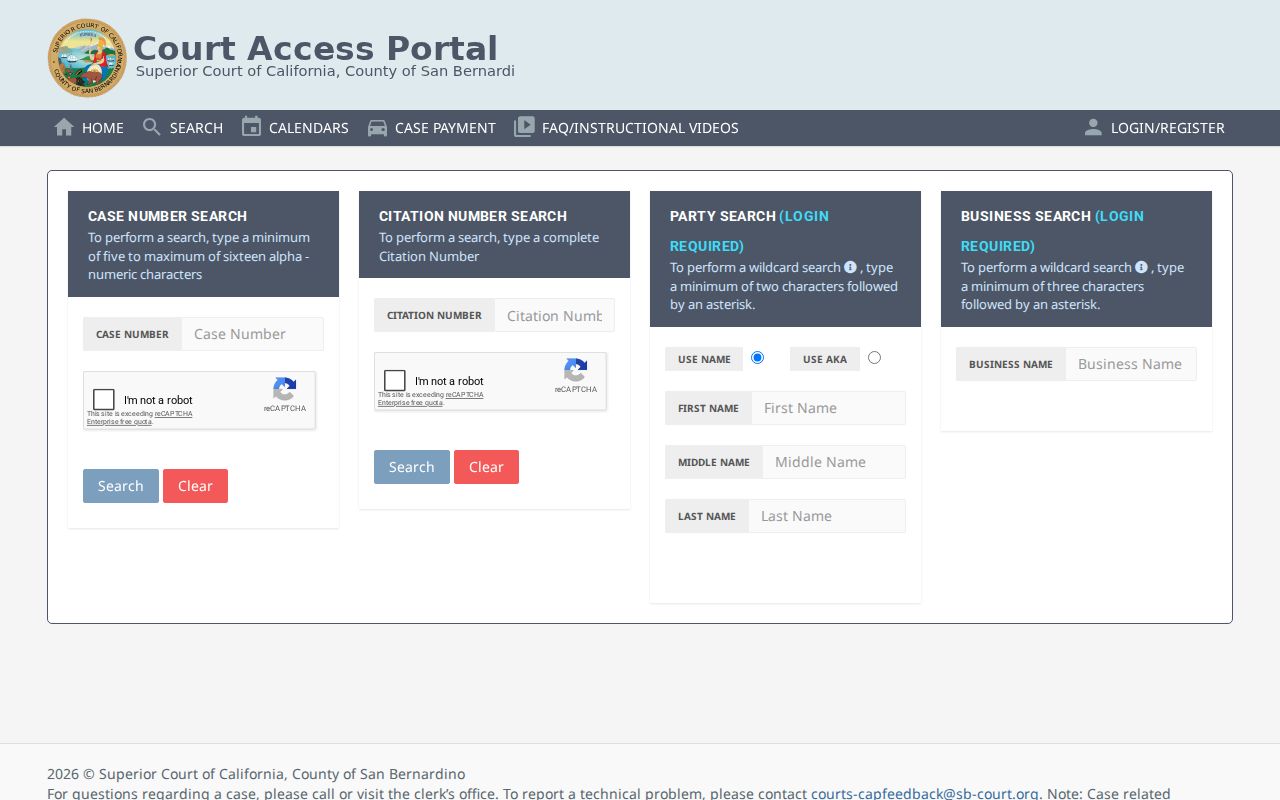
Use a case or citation number when possible. The court identifies that as the easiest way to locate the right record.
Trace Santa Barbara County Vital Records
The Santa Barbara County Clerk-Recorder issues copies for county birth, death, fetal death, and marriage events. County marriage records reach from the current year back to 1850 when the license was issued here. Divorce follows a different path: the Superior Court keeps local dissolution records, not the Clerk-Recorder. For events outside the county, the county of occurrence or California Department of Public Health is the right fallback. CDPH also handles amendments to birth, death, and public marriage certificates.
California does not make vital records open merely because a fixed number of years has passed. The key difference is an authorized certified copy versus an informational copy. Health and Safety Code sections 103525 and 103526 govern eligibility, identification, and sworn statements. Informational birth, death, and public marriage copies carry a warning that they are not valid to establish identity. Confidential marriage copies are limited to the parties or a court order.
For an authorized county copy, the applicant may appear in person or print the application, complete the required notarized sections, and return it by mail or fax. Email is not accepted. The county portal lists 2026 fees of $34 for birth, $26 for death, $23 for fetal death, and $19 for marriage.
Find Santa Barbara County Heirs
Probate, obituaries, cemetery indexes, and deeds form a strong official trail for a deceased person and possible heirs. Begin with the Superior Court Public Portal for a non-confidential probate register. Probate covers decedent estates, guardianships, and conservatorships. A register can identify the case and event sequence, while petitions and other file documents may require a court request or in-person review. Then compare the decedent's address with recorded deeds and tax records.
The Santa Barbara Public Library local history service accepts obituary and local-history requests and points researchers to the county genealogical society's obituary database.
Obituaries can add relatives, maiden names, former addresses, occupations, funeral homes, and groups that help distinguish one person from another. Historical newspapers are available through Newspapers.com for in-library use at the Central, Eastside, and Montecito libraries. The Genealogical Society also indexes local birth, death, marriage, court, naturalization, burial, and cemetery sources.
Santa Barbara County Geography Changes Searches
A countywide name can lead to very different custodians. South Coast research may involve the City of Santa Barbara, Goleta, Carpinteria, Montecito, Isla Vista, UCSB, and county offices. North County records may point to Santa Maria, Orcutt, Lompoc, Vandenberg, Guadalupe, or county service centers. Rural searches can involve Cuyama, New Cuyama, Ventucopa, or Gaviota. Some ZIP codes cross city and unincorporated lines, so the keeper may be a city, county, school district, special district, or federal office.
Names also shift with place. University records may use UCSB, Goleta, or Santa Barbara for the same area. Older directories may group Montecito, Goleta, Hope Ranch, Santa Maria, and other county communities under a broader title. Military-era sources may use Vandenberg AFB. Record each place name exactly as shown and test nearby community names rather than assuming one modern label has always applied.
The City of Santa Barbara formalized street numbers along State Street in 1875. Earlier deeds, tax entries, directories, and newspaper notices may rely on landmarks, ranchos, lots, water claims, or informal street descriptions. A historical directory or map is often the bridge between that old place and a modern parcel.
Search Santa Barbara County Historical Records
Santa Barbara County's recorded past reaches to the first year of county government. The Board Historical Minutes Archive begins on November 18, 1850. Sixteen hard-bound ledgers hold handwritten minutes through 1907; later minutes were typed, microfilmed, and moved online. These records can place named officials, petitioners, contractors, and residents in a public decision even when they never appear in a modern directory.
Clerk-Recorder historical holdings include real estate and vital records from 1850 to the present and recorded maps across the same span. Selected online material includes the Water Claims Book from 1877 through 1918, a rare route from a claimant or organization to a creek, ranch, irrigation right, or early land use. The current name index and office archive are not identical, so nineteenth-century research may require staff help or a historical workflow.
The Sahyun Genealogical Library holds printed city directories from 1886 through 1991, including Santa Maria and Lompoc coverage. Its society also offers more than 200,000 digitized local documents and indexes. City directories can reveal a spouse, occupation, place of business, street address, and sometimes a reverse street listing. Those annual snapshots help move a family between census years.
Note: Keep original spellings when searching old indexes, then test initials, variant surnames, and the community names used during that time.
Check Santa Barbara County Custody Records
The Sheriff's Who Is In Custody search accepts first name, last name, or inmate number, also called a CID. Public information can include custody location, charges, status, and CID. The Sheriff warns that the data should not be relied on for legal action. Call the Main Jail at 805-681-4260 or the Santa Maria North Branch Jail at 805-554-3100 when the online result needs confirmation.
State prison custody belongs in the California Department of Corrections and Rehabilitation Inmate Locator, which searches by name or CDCR number. Federal custody uses the Bureau of Prisons locator, including current and released federal inmates since 1982. The California Megan's Law registry is a separate state system with strict legal-use terms. Check the official source that matches the type of custody rather than treating one roster as a complete history.
Note: A current custody entry reports a present status; it does not by itself prove the final outcome of the charge or case.
Find Santa Barbara County Business Records
A business name can lead back to people through three layers. The county Clerk-Recorder's fictitious business name search covers existing, abandoned, and withdrawn filings, which can connect an assumed business name with registrants and addresses. California's state business registry covers corporations, limited liability companies, and other entities, with filing history, status, agents, addresses, and free copies where available. Its UCC search can use a debtor, secured party, or file number.
Professional records add a different check. California's statewide consumer-license lookup verifies licenses issued by participating boards and can show current, expired, or disciplinary status. Separate official lookups cover attorneys, contractors, real estate licensees, medical professionals, teachers, and other regulated fields. Search both the person's name and the business name because an entity filing, county FBN, and professional license can use different forms of the same identity.
Santa Barbara County Voter Lookup Limits
The county's Verify Your Voter Registration page serves voter self-service, while the sample-ballot and polling-place tool browses by ZIP code and community. Neither should be treated as an unrestricted people directory. The full county voter file requires a written application and a purpose permitted by California Elections Code sections 2187, 2188, and 2194, such as an election, scholarly, journalistic, political, or governmental use.
A non-confidential voter record may include name, residence or mailing address, party preference, registration status and date, precinct, districts, vote-by-mail status, and participation history. Participation shows whether someone voted in an election, never the ballot choices. Signatures, driver's license or state ID numbers, Social Security numbers, and protected voter details remain confidential. The county application also bars sale, lease, loan, or transfer without written authorization.
Safe at Home and county confidential registration protect residence information for qualifying voters. The fuller legal and request process appears in Santa Barbara County voter records.
Compare Santa Barbara County Search Sources
Official sources are strongest when a current filing, authenticated copy, or named custodian matters. Libraries and archives are better for past residents, family links, address changes, obituaries, and organizations. Commercial people-finder services combine many datasets, but the result may be stale or merge people who share a name. Treat any compiled profile as a lead that must be checked against the office or archive that created the underlying record.
| Source type | Best use | Main limit |
|---|---|---|
| County and court portals | Current filings, parcels, cases, custody, official indexes | Remote images and protected fields may be limited |
| Libraries and archives | Former residents, obituaries, directories, family and group records | Some collections require an in-person visit or staff request |
| State registries | Business entities, licenses, prisons, unclaimed property | Coverage follows the state agency's scope |
| Commercial compilations | Generating a possible lead | Stale data, merged identities, unclear source dates |
Request Santa Barbara County Public Records
The California Public Records Act, Government Code section 7920.000 and following, is the fallback for county and city administrative records not supplied through a standard portal. Describe an identifiable record, date range, office, subject, and known name or address. An agency need not create a new record, answer questions, or do legal research. It generally determines within ten days whether responsive records are disclosable and may add up to fourteen days in unusual circumstances.
Ask for electronic copies when they exist and request an estimate before paid duplication. Fees are usually tied to direct duplication costs unless a statute sets a specific amount, as with recorder, court, or vital copies. If part of a record is exempt, ask whether the agency can redact the protected portion and release the rest. Juvenile cases, adoptions, sealed files, protected voter data, confidential marriages, identifying numbers, and some law-enforcement material have separate limits.
Note: Court case files follow court rules and statutes, while the Public Records Act governs court administrative records rather than the case record itself.